There’s a story that, as women, I think many of us know far too well.
It might be one we’ve lived ourselves, one shared, or one we’ve never quite found the words to explain. A story about changing a route, changing a workout, or changing how we show up in a space because something—or someone—made us feel uncomfortable.
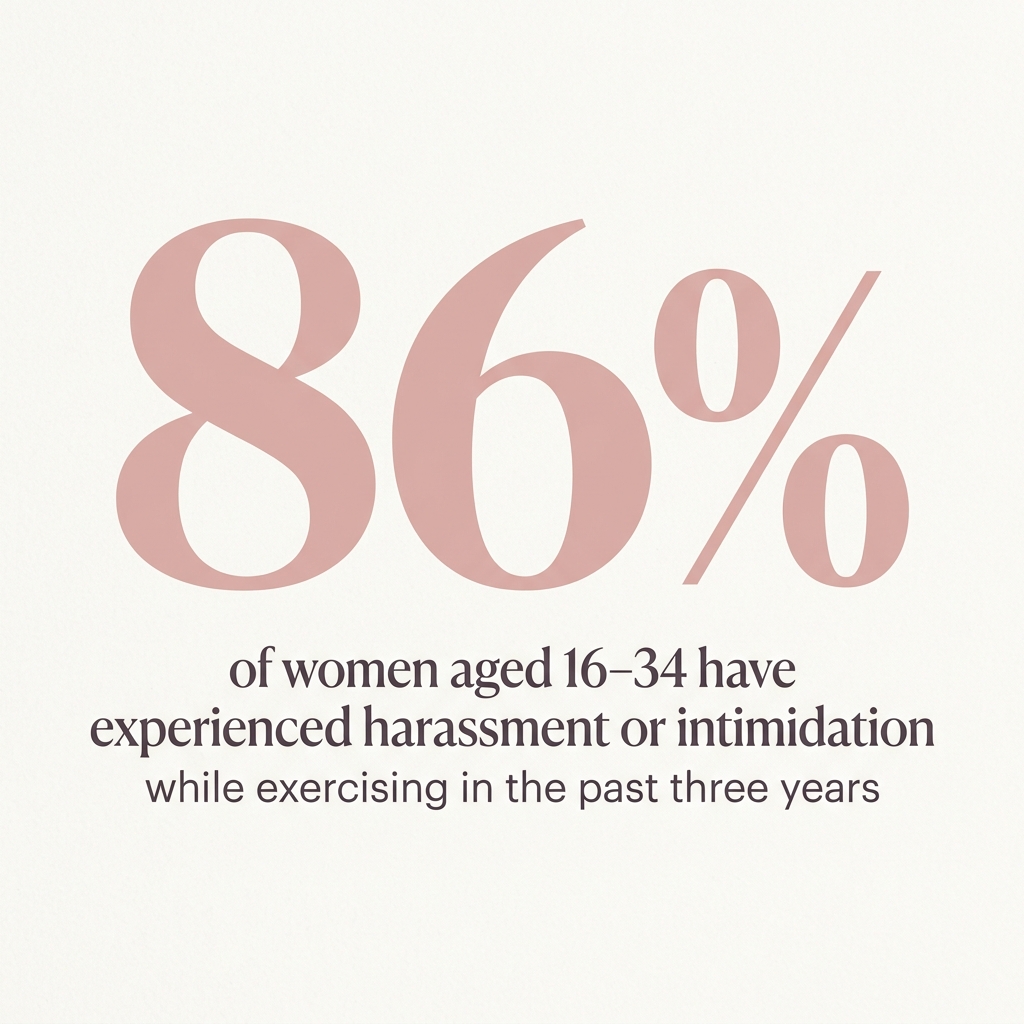
Today, this story starts with a number. In an exclusive first look, Marie Claire UK reveals new Sport England research showing that 86% of women aged 16 to 34 have experienced harassment or intimidation while exercising in the past three years.
Read that again.
We’re not talking about one woman having one uncomfortable interaction in a changing room. Nor an awkward moment that someone has brushed off as “probably nothing”. It’s a pattern of experiences that are shaping how women move, in spaces that are supposed to make them feel stronger.
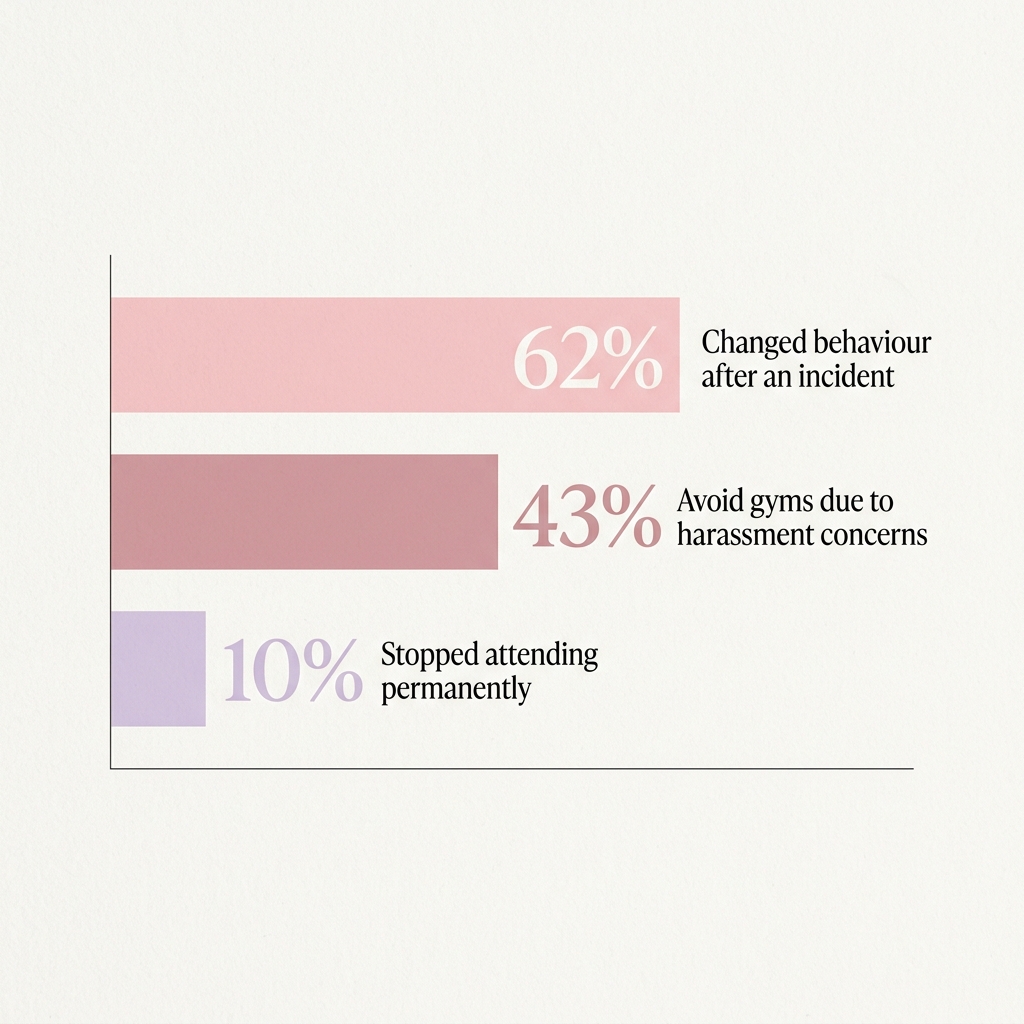
The report also reveals that 43% of women aged 16 to 34 who don't currently use gyms or leisure centres say concerns about sexual harassment have directly influenced their decision not to attend. Among women who do use these spaces, 62% say they have changed their behaviour after experiencing or witnessing harassment or intimidation. At the same time, one in ten have stopped using a workout space permanently following an incident.
The findings arrive at a time when women’s participation in fitness is quite literally booming: 7.6 million women now routinely take part in fitness activities—1.4 million more than 2021—with Gen Z leading the charge through strength training and gym-based exercise.
The message is crystal clear: women want to be in these spaces. The question is whether those spaces are making women feel safe enough to stay.
New Sport England Research Confirms a Worrying Barrier to Entry for Women: Not Feeling Safe
Sadly, these numbers aren't just statistics: they're the lived reality of millions of women worldwide.
The new Sport England research asks a simple question: how safe do women actually feel in gyms, leisure centres and other places where we’re supposed to be getting active and feeling safe doing so?
The answer is uncomfortable. Only 46% of women aged 16 to 34 believe these spaces are as safe and welcoming for women as they are for men. Let that sink in for a second. Fewer than half of us walk into a gym believing we’re on equal footing before we’ve even picked up a dumbbell.
Only 45% think enough is being done to tackle harassment and intimidation.
If you’re 16 to 24, the concern is even greater. The generation driving the current gym boom is also the generation most worried about what might happen when they get there.
And the numbers go on.
If you’ve ever hovered at the edge of the weights area pretending to stretch while you work up the courage to walk in, the figures probably won't surprise you.
But that's what's most worrying. According to the research, 78% of women aged 16 to 34 have experienced non-verbal harassment: the staring that lasts a little too long, the lingering nearby, the man who seems to follow from machine to machine without ever technically saying anything. It’s awkward to explain, even harder to report, and very easy for someone else to brush off, which is exactly why so many women end up second-guessing themselves instead of the behaviour.
So when women say they’ve changed how they use the gym, they’re really not being “dramatic”. 62% have changed their behaviour after experiencing or witnessing harassment or intimidation. And the changes are painfully familiar: 29% avoid dressing in a certain way, 29% avoid going at certain times, and 29% avoid areas of the gym that usually have more men.
Perhaps the statistic that says the quiet part out loud: 43% of women aged 16 to 34 who haven’t used a gym in the last year say concerns about sexual harassment influenced that decision.
The details are in the data. They reveal not just how many women feel unsafe, but the small, everyday decisions they are making because of it. But numbers can only take us so far. To understand what this really looks like, we spoke to the women who've experienced it firsthand.
"I Changed My Workout Before I Changed Gyms"
What’s particularly striking is that while the data shows just how widespread these experiences are, many women were still reluctant to come forward and share their stories. But perhaps that isn’t so surprising. These moments can be difficult to explain, easy to dismiss, and often leave so many questioning whether what happened was “bad enough” to talk about in the first place.
But whether it’s a comment shouted across the street, unwanted eyes in the gym, or simply the feeling of being watched, the impact is real. The real issue is that these experiences are so often reduced down to “just” something: just a comment, just banter, just an awkward interaction, despite the research showing that they can shape whether women feel able to exercise freely at all.
Ally Head, Senior Health Editor at Marie Claire UK, knows that feeling all too well. During lockdown, while training for a 37-mile ultra marathon, she experienced something that would go on to change the way she approached running forever.
"It was peak lockdown, and I was banking a training run when it happened. Alone, on a deserted street in central London, a man backed me down an alleyway, shouting abuse and squaring up to me."
"I’ve never felt fear like it. For what felt like an eternity but was probably a minute, I genuinely didn’t know what he was going to do next. Eventually, he backed off, and I made it home—physically unscathed, but mentally shaken up."
"Sadly, it wasn’t an isolated incident. Catcalling, heckling, and unsolicited comments all seem to be part and parcel if you’re a woman who moves her body in public. I've experienced it on the street, in the gym, and in parks."
"It took years to rebuild my confidence—I still haven’t run with both headphones in, and I still rarely wear my hair in a ponytail or plait, in case someone were to grab it."
"In the aftermath, I found myself doing what so many women do: interrogating my own behaviour instead of his. Were my shorts too short? My top too revealing? Had I taken an unsafe route? It took time to understand that I wasn't the problem—and I should never have been made to feel like I was."
What this research exposes is a sad fact: that too many of us are treating safety planning as part of our workout routine—and we’ve become so used to it that we barely bat an eyelid.
In 2026, I shouldn't have had to feel afraid to exercise. Safety concerns shouldn't be a barrier to entry for women wanting to workout.
Ally Head
We Need Safer Spaces to Move—So What Happens Now?
The fitness industry’s latest answer to women’s safety concerns is often female-only spaces. And while many women genuinely value them, there’s an uncomfortable question attached to their popularity: isn’t it worrying that we’ve had to create a separate space all in the name of avoiding harassment while exercising?
Women shouldn't need their own corners of the gym. They should feel comfortable—and safe—enough to workout in exactly the same spaces men do.
Yet sadly, the Sport England research shows women don't have the luxury of simply deciding whether they want to exercise. Instead, we're having to decide how to make exercise feel manageable. From the time we consider working out, we're having to avoid certain spaces, carefully choose what to wear, and pick which moments we choose to ignore, rather than challenge, because we don’t want the situation to escalate.
We’ve become so accustomed to these adjustments that they've started to look like normal gym behaviour rather than a response to feeling unsafe.
That is exactly what This Girl Can and Sport England want to change. Claire Edwards, Head of Campaign Activation at Sport England, says the biggest takeaway isn't just the scale of the issue, but what responses revealed. “The fact that 62% of women changed their behaviour after experiencing or witnessing harassment or intimidation underlines how much women want to be in these spaces. They're adapting themselves to be able to stay within them.”
But there is a limit to how much adapting women can be expected to do. As Edwards explains: “Constantly having to make these adjustments will become exhausting and ultimately push women away from being active in these spaces altogether.”
The answer, she says, is not asking women to shrink themselves—it’s creating environments where they no longer feel they have to.
That is where Safer Spaces to Move comes in. Developed by This Girl Can and ukactive, the resource hub provides gyms and leisure operators with practical tools, training, policies, and guidance to help prevent harassment, respond appropriately when incidents happen and build trust with their members.
Creating Environments Where Women and Girls Feel Safe
It's not all bad news, and there are also signs of progress. Since the launch of Safer Spaces to Move, more women are reporting clearer codes of conduct, processes and information about where to go for support at their fitness centres.
For Edwards, the ambition is simple: “To create environments where women and girls feel safe, welcome and confident to be active.”
For all the uncomfortable truths in this research, there is hope. What should give us genuine optimism is that women aren't retreating from fitness—far from it. We're showing up in record numbers, community in tow. We're taking up space in weight rooms, signing up for running events, learning to lift heavy, and proving that the desire to move, train and feel strong is not the issue.
It's clear that the fitness and health sector is stepping up and leading the way on women’s safety—but there is so much more to do to ensure all spaces are safe and welcoming.
If this research achieves anything, it's this: we need to stop treating women's safety calculations as an inevitable part of exercise, and start treating them as a problem that can—and should—be designed out of the experience altogether.
from Latest from Marie Claire UK https://ift.tt/C7Go1yR
via IFTTT

No comments:
Post a Comment